

3GPP Non-Terrestrial Networks: the role of GCF Certification
- 30 Jul 2026
- Carlos Pedraz
Introduction
Satellites have been part of our communications infrastructure for decades, but it’s only recently that direct satellite links have started to become a mainstream technology for everyday devices – which includes both our regular cell phone handsets, and internet of things (IoT) endpoints such as wearables, automotive or remote sensing devices.
This has been enabled mainly by increased capacity, improved satellite technologies and falling costs of launches that facilitate the development and densification of low earth orbit (LEO) constellations. These evolutions enable mobile-type communications, with higher data throughputs and low latencies that allow users to make video calls, browse the web, and use their apps from anywhere on earth.
Today, there are two main approaches to the technology required to create direct satellite links to our devices: using existing LTE or 5G technologies to provide direct to device (D2D) connections to unmodified devices using frequency bands initially considered for terrestrial connectivity (D2D-IMT) or using the newer Non-Terrestrial Networks (NTN) standards for broadband (NTN 5G NR) or IoT (NTN-NB IoT) connections over dedicated satellite spectrum (D2D-MSS).
In this article, we’ll compare these two options and look at the vital role of industry standards in enabling efficient, reliable satellite communications.
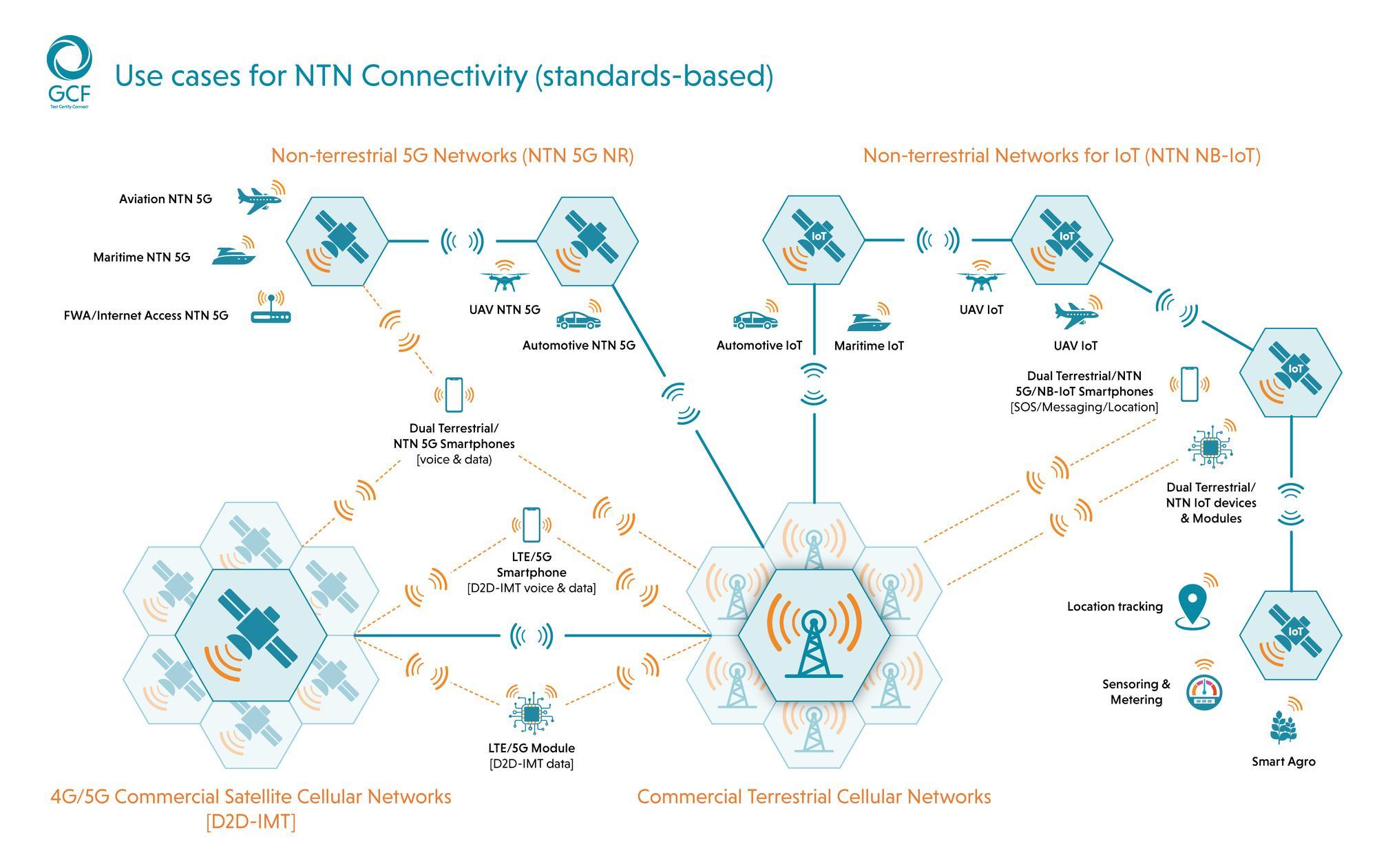
Figure 1: Key NTN Use Cases
D2D-IMT and NTN compared
D2D-IMT connectivity uses unmodified 3GPP standards and frequency bands between devices and satellite networks. This enables it to provide cell phone connectivity in remote or rural areas without ground-based network coverage, including oceans. This can also be valuable for IoT applications, such as tracking the position of a road vehicle as it drives through areas without cell coverage, or a container in maritime transit.
D2D-IMT also provides a level of redundancy for mobile communications where the terrestrial network is disrupted, for example to deliver emergency alerts and text messages during hurricanes or other natural disasters. As it uses the existing 3GPP protocols and frequency bands, the satellite provider must work with the relevant terrestrial mobile operator, to avoid interference, especially on network borders, and to provide seamless transitions for the user (whether a person or an IoT endpoint) from terrestrial-based to satellite connectivity.
Alternatively, with the adoption of 3GPP standards-based satellite connectivity, manufacturers can now design their devices for broadband or IoT satellite connections using specific 3GPP standards. Direct connectivity between devices and satellites, using NTN standards and specific frequency bands, is also referred to as D2D-MSS.
3GPP Release 17 added two principal specifications: NTN NB-IoT for IoT use cases, and NTN 5G NR for data and voice-oriented applications over two specific FR1-NTN bands: 255/n255 (L-band) and 256/n256 (S-band).
Additional enhancements were introduced in 3GPP Release 18 to improve mobility, handover, capacity, and also adding additional bands as shown in Figure 2.
Release 19 introduces NR NTN operation for RedCap and eRedCap devices, providing energy-efficient IoT services across NTN FR1 bands and adding support for regenerative satellites. This means a satellite payload that has some network intelligence itself, such as a gNB base station – as opposed to being basically a relay for a terrestrial base station. The regenerative payload can add new capabilities, such as ‘store and forward’, where data that is not time-critical can be stored at the satellite or the device if there is no suitable link available, and sent later when connectivity is regained. The regenerative architecture also provides more flexibility, better performance and global coverage due to the ability to support inter-satellite links.
Release 19 also adds support for additional bands for NTN NB-IoT, FR1-NTN 5G NR in extended L-band and FR2-NTN 5G NR bands in MSS Ku-band.
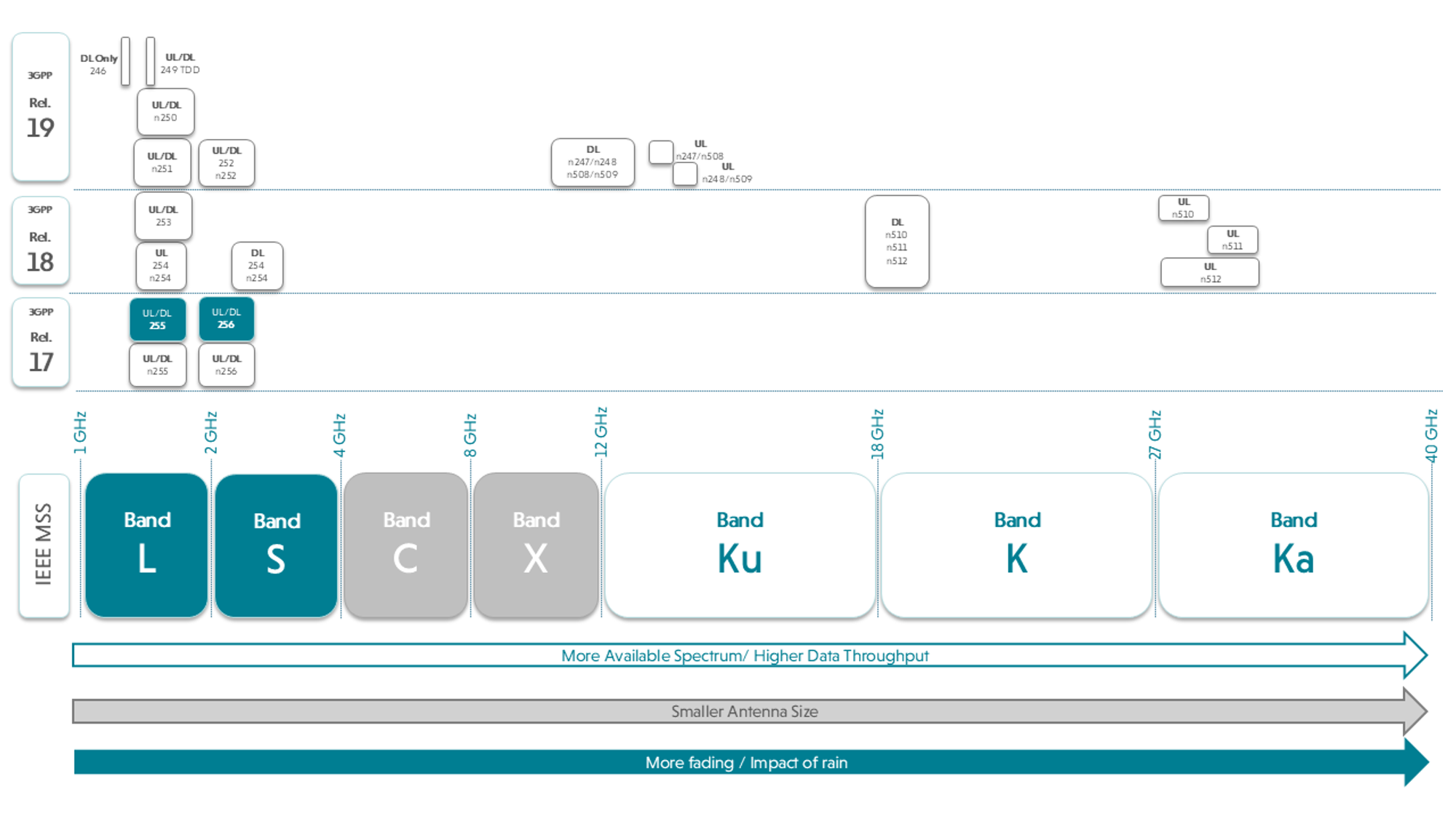
Figure 2: NTN Frequency bands vs IEEE MSS bands evolution in 3GPP Specs
The table below lists some of the key attributes of D2D-IMT (unmodified LTE and 5G NR), NTN 5G NR and NTN NB-IoT for low earth orbit (LEO) and geostationary earth orbit (GEO) satellites. LEO satellites operate at altitudes typically between 500 km and 2,000 km, which makes them relatively low cost to launch and enables low latency communications, but does introduce problems due to the high speed of satellites relative to the ground below. In contrast, GEO satellites need to achieve an altitude of more than 35,000 km to maintain their position above a fixed point on the earth’s surface, resulting in much higher latencies and required power link budgets.
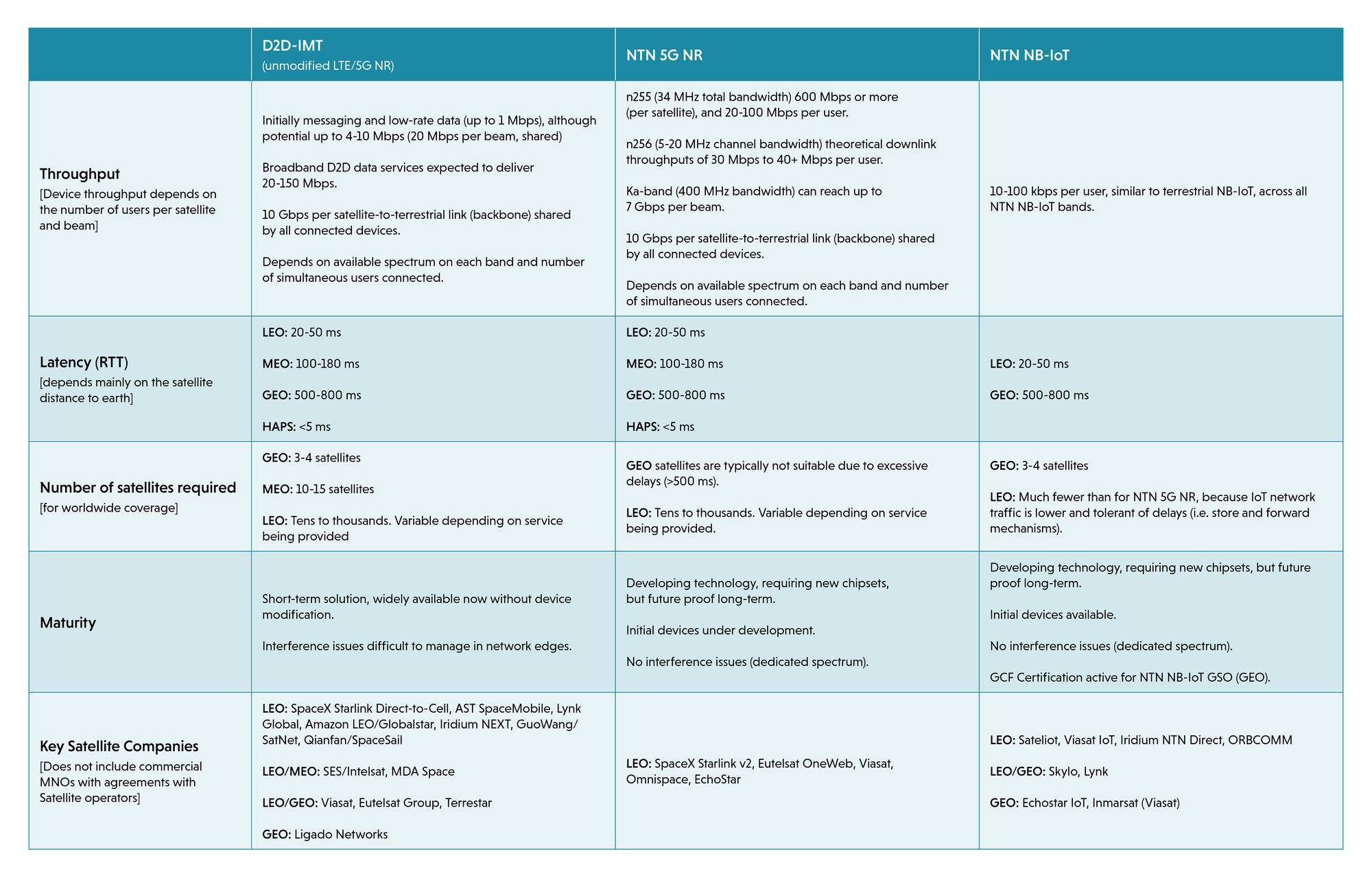
Table 1: D2D-IMT and NTN compared (Sources: 3GPP; NTN and 3GPP standards presentation; Sedin et al.)
So far, a number of NTN-capable smartphones and wearables have become available commercially, mostly for basic messaging and emergency services in areas beyond terrestrial network coverage. Several smartphone vendors provide emergency contact via satellite, while Qualcomm, MediaTek and Samsung have all announced modems or SoCs (Systems-on-Chip) supporting both NTN NB-IoT and NTN 5G NR technologies for the development of end products, such as smartphones or wireless routers.
What does GCF offer?
As with any mobile technology, satellite needs industry standards, to ensure interoperability between networks and the devices using them. Certification is vital, to give operators the confidence that products meet these standards and can be safely deployed on their networks.
The Global Certification Forum (GCF) already covers D2D-IMT, because the devices are using unmodified LTE and 5G NR protocols that are certified for terrestrial use within existing GCF certification programmes. GCF is also well prepared to include potential enhancements to D2D-IMT connectivity, as part of the constant evolution of the certification requirements and certification criteria.
Satellite-focused operators have started to join GCF, and satellite operators and NTN-oriented manufacturers are both key to providing expertise to the development of certification capabilities for devices connecting to satellite networks, very often in cooperation with traditional, terrestrial-oriented mobile network operators. This expertise targets both GEO constellations (also known as geostationary orbits, GSO) and LEO constellations (also known as non-geostationary orbits, NGSO).
In 2024, GCF introduced support for 3GPP Release 17 NTN NB-IoT for GSO in bands 255 and 256 to its certification programme. Support for NGSO for both NTN NB-IoT and NTN 5G NR devices is expected to follow during 2026. The first chipset supporting NB-IoT NTN was certified during 2024, with two additional NB-IoT NTN devices certified in 2025.
GCF’s certification scope
GCF’s current certification scope includes NTN NR and NTN NB-IoT (as well as the mature LTE and 5G NR technologies used for D2D-IMT). Industry is still analysing and developing field trials test specifications for NTN, so the initial focus of GCF Certification is set specifically on conformance testing.
For NTN NB-IoT, GCF is working actively to complete conformance criteria for GSO (GEO constellations) with the addition of new WIs (work items) of 3GPP Release 17 and 18, as well as to activate conformance criteria for NGSO (LEO constellations). This will initially be for bands 255/256 and is expected to happen during 2026.
For 5G NR NTN, GCF is working to activate during 2026 conformance criteria for Release 17 NGSO (LEO) with an initial WI. Again, this is initially for bands n255 and n256.
As GCF is member- and contribution-driven, industry, and user demand will define the priorities for the evolution of GCF certification programs for devices accessing Non-Terrestrial Networks.
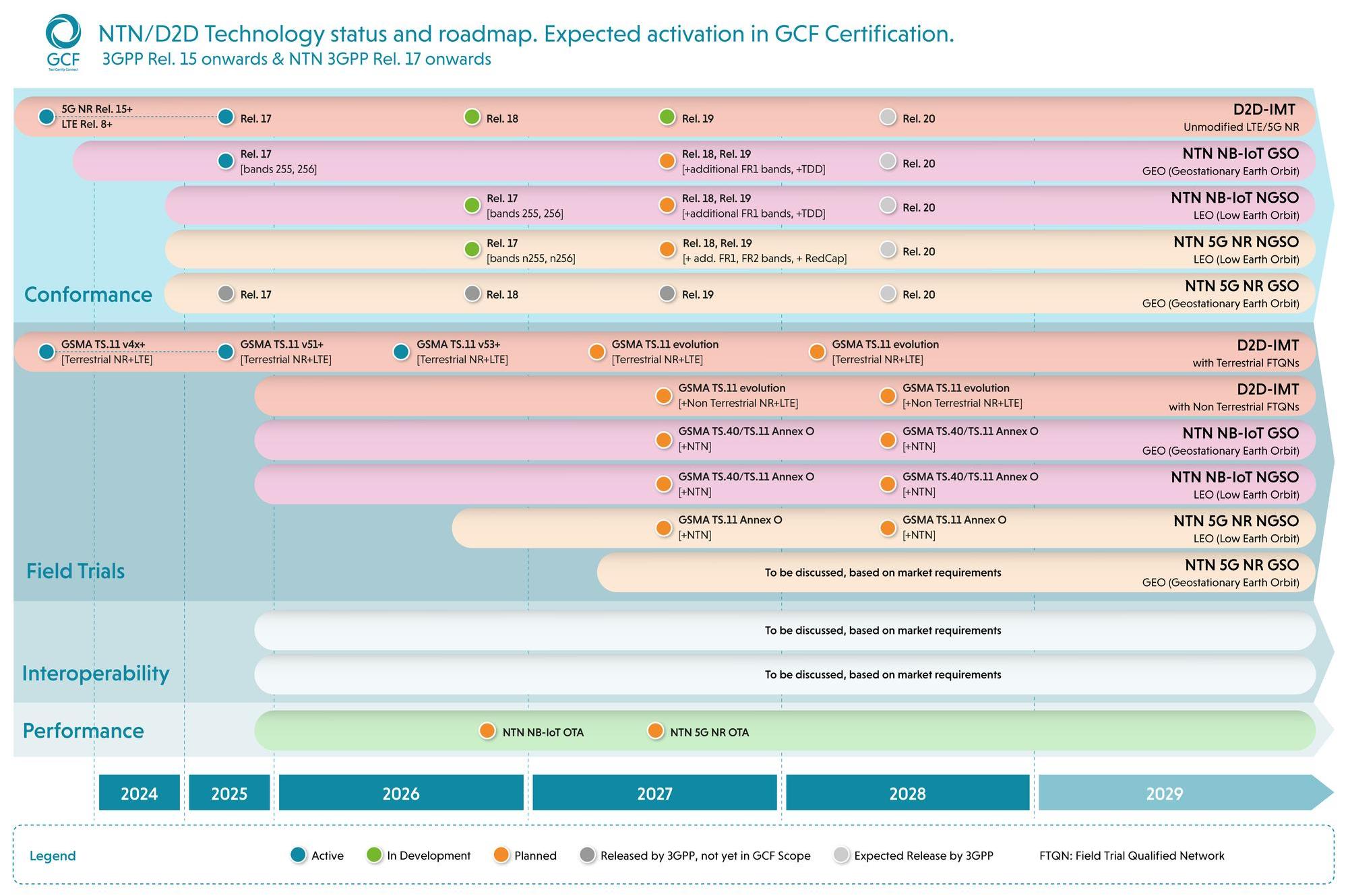
Figure 3: NTN/D2D Technology status and roadmap. Expected activation in GCF Certification
GCF is also actively working with the industry to develop and activate field trial testing for NTN-capable devices, based on GSMA TS.11 Annex O Test Specification and GCF Procedures, including the use of FTQN (Field Trial Qualified Networks) specifically declared for this purpose.
Interoperability testing in controlled scenarios (i.e. laboratories or test networks, as opposed to commercial networks) is also a possibility. It has been recently launched by GCF for testing interoperability of mission critical broadband services prior to the availability of testing scenarios in commercial networks.
GCF is setting up agreements with industry stakeholders to avoid fragmentation between terrestrial and NTN in relation to device certification.
Looking ahead
The potential market for satellite communications is huge: GSMA Intelligence forecasts over US$30 billion extra annual revenue by 2035. This is expected to be partly due to up to 2 billion satellite IoT connections, while satellite also addresses the hundreds of millions of people who are still without mobile broadband.
GCF expects to see strong growth in the certification of modules and smartphones supporting basic messaging and emergency capabilities over NB-IoT NTN satellite networks. NTN D2D-IMT, based on LTE and 5G connectivity, will continue to rise, with more satellite operators activating services in this area and densifying their satellite networks.
With the huge installed base of LTE devices, there is a short-term opportunity to rollout D2D-IMT services relatively easily. In the longer term, the technology advantages of NB-IoT NTN and 5G NR NTN will make them the preferred option in many use cases. As we move from 5G to 5G-Advanced, and beyond that to 6G, there will be an increased level of support for NTN, as well as improved NTN/TN interoperability in the 3GPP standards, ensuring new capabilities become available.
While certification for NTN devices has started in L and S satellite bands, evolution to Ka and Ku satellite bands, standardized in 3GPP Release 18 and onwards, are expected to follow. Also, technologies such as HAPS (High Altitude Platform Stations) are expected to become a commercial reality in the following years, using drones or balloons to target access networks being deployed in the stratosphere for local network coverage, (altitudes around 20km, above commercial aviation routes).
To enable successful growth of the satellite market, compliance to 3GPP standards will be essential – supported by GCF certification, now and in the future.
Co-author:
Isabel Rosa, Head of Certification 5G & Automotive, Global Certification Forum (GCF)
Author(s)
